
Specialist Piano Removals
in South Wales
Your piano moved safely by trained specialists with purpose-built equipment. No scratches, no damage to your property, and no risk to a valuable instrument that deserves expert handling.
Hundreds of pianos moved safely across Wales — specialist equipment and fully insured.
200+
Pianos Moved
100%
Fully Insured
Zero
Damage Record
Specialist
Equipment
5★
Customer Rating
Why Piano Removals Require Specialist Handling
Pianos are among the most challenging items to move. An upright piano weighs between 150kg and 300kg. A baby grand can weigh 250kg or more. A full concert grand can exceed 500kg. These instruments are not just heavy — they are delicate, awkwardly shaped, and extremely valuable.
Our piano removal service is designed for homeowners, schools, churches, music venues, recording studios, and anyone who needs a piano moved safely within South Wales or across the UK.
Professional piano movers use specialist equipment that standard removal companies do not carry. This includes piano skids (wheeled platforms designed for piano legs), heavy-duty straps rated for the weight, padded covers that protect the finish, and stair-climbing equipment for properties without ground-floor access.
Attempting to move a piano without this equipment risks catastrophic damage — to the piano, to your property, and to the people involved. Dropped pianos destroy floors, doorframes, and staircases. They also cause serious crush injuries.
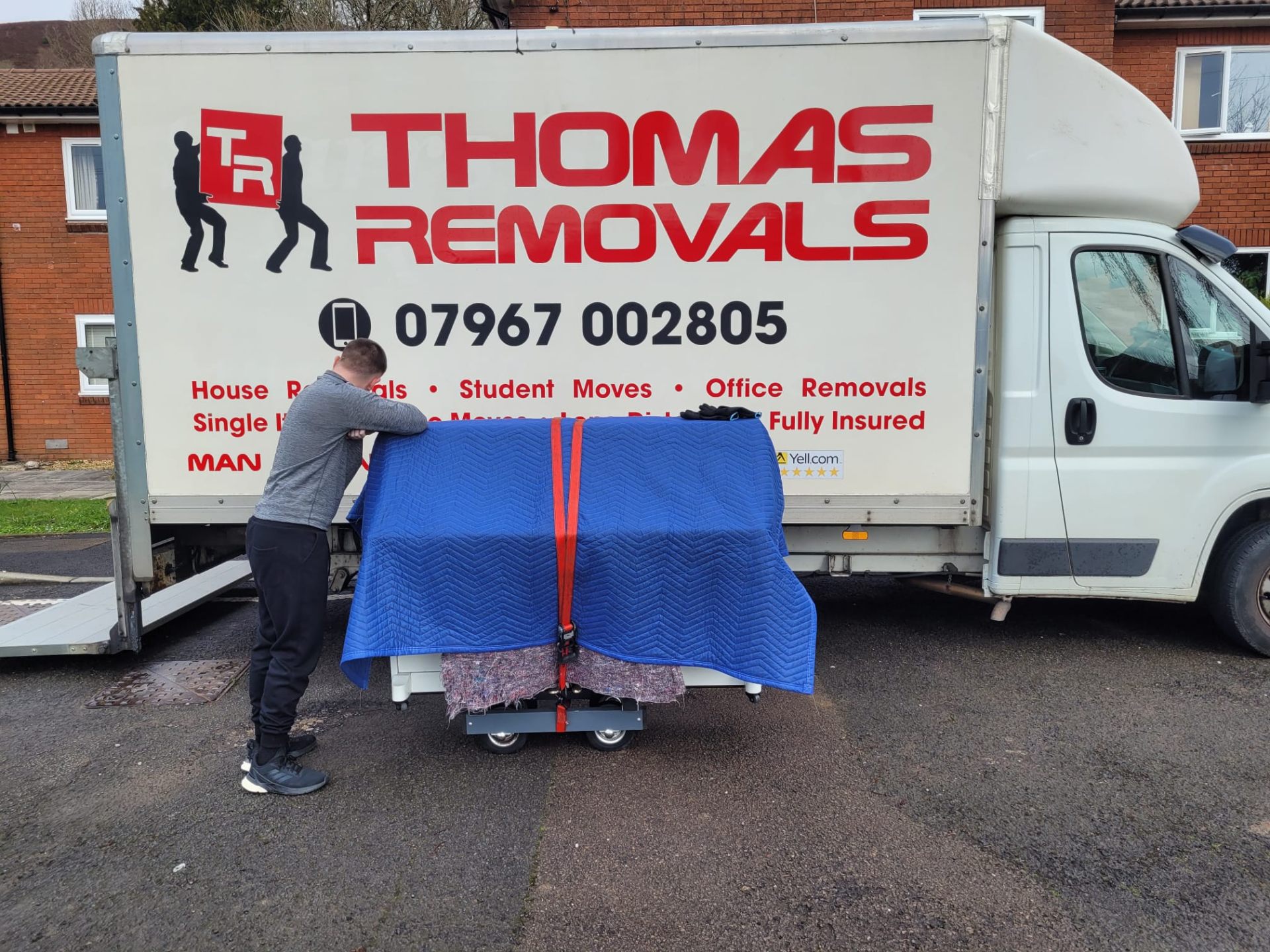
Specialist Piano Moving With Protective Wrapping
Every piano is carefully wrapped with specialist padded covers and secured with heavy-duty straps. Our team uses purpose-built piano trolleys to navigate narrow hallways and doorways safely.
The Consequences of Attempting a DIY Piano Move
A piano is not furniture. It is a precision instrument containing thousands of moving parts — hammers, strings, dampers, keys, and pedals — all calibrated to work together. Impact, tilting, or vibration during transport can knock the action out of alignment, crack the soundboard, or snap strings.
The most common DIY piano moving disaster is the staircase. Pianos have a very high centre of gravity, and on stairs they become extremely difficult to control. Without proper stair-climbing equipment and training, the piano will tip, fall, and cause serious damage to the instrument, the staircase, and potentially the people trying to hold it.
Even on flat ground, pianos on standard furniture dollies are dangerous. The castors can catch on carpet transitions, door thresholds, or uneven flooring, causing the piano to lurch sideways. Piano skids are specifically engineered to handle these transitions smoothly.
Insurance is another critical factor. Most home insurance policies do not cover damage to pianos during a move unless professional movers are used. Our specialist piano insurance covers the full value of the instrument during transit.
Our Proven Process
Assessment
We identify the piano type, weight, dimensions, and access at both locations. Stairs, tight corners, narrow doorways, and parking are all assessed.
Equipment Preparation
Based on the assessment, we prepare the correct equipment — piano skids, straps, padded covers, stair-climbers, and protective materials for flooring and walls.
Protection & Wrapping
The piano is closed, locked, and wrapped in padded covers. The keyboard lid is secured, and legs are protected or removed if necessary.
Careful Transport
The piano is loaded onto our vehicle using ramps and positioned upright in a dedicated, padded area. It is strapped securely to prevent any movement.
Delivery & Placement
At the destination, the piano is unloaded with the same care, carried to its final position, and unwrapped. We recommend allowing it to acclimatise before tuning.
What You Get With Thomas Removals
Specialist Equipment
Purpose-built piano skids, heavy-duty straps, and padded covers designed specifically for safe piano transport.
Trained Piano Movers
Our team has handled hundreds of pianos and understands the weight distribution, balance points, and vulnerabilities of every piano type.
Property Protection
Floors, doorframes, walls, and staircases are protected with boards and padding before the piano is moved through.
Full Insurance Cover
Specialist piano insurance covers the full replacement value of the instrument during the entire move.
Stair Capability
We have equipment and experience to move pianos up and down stairs safely, including the tight staircases common in Welsh terraced houses.
Post-Move Advice
We advise on piano placement for optimal sound quality and recommend waiting 2-4 weeks before tuning to allow the instrument to adjust to its new environment.
Piano Moving: Types, Techniques, and What to Expect
Upright pianos are the most common type we move. They range from small cottage uprights (around 100cm tall) to full-size professional uprights (130cm+). Uprights are moved on their base using piano skids, with the keyboard side always facing the direction of travel.
Grand pianos — including baby grands, parlour grands, and full concert grands — require a different technique. The lid is removed and wrapped separately. The piano is then carefully tipped onto its side (always the flat side down) and placed on a padded skid board for transport.
Digital pianos and stage pianos are lighter but still require careful handling due to their electronic components and often fragile legs. We treat them with the same care as acoustic instruments.
Staircase moves are the most technically demanding piano jobs. For straight staircases, we use stair-climbing equipment that controls the descent or ascent with hydraulic braking. For spiral or dog-leg staircases, we may need to remove banisters or use crane access through windows.
We have moved pianos in and out of terraced houses in Tonypandy with front doors opening directly onto narrow pavements. We have navigated pianos through the tight corridors of Pontypridd schools. And we have handled valuable instruments for churches across the Rhondda Valley. No access challenge is new to us.
Climate and humidity affect pianos significantly. When moving a piano from a heated home to a cold storage unit, or vice versa, the soundboard can crack from rapid temperature changes. We advise on acclimatisation and, where possible, recommend climate-controlled environments for valuable instruments.
After your piano has been moved, we recommend waiting two to four weeks before having it tuned. The strings, soundboard, and wooden components need time to settle and adjust to the temperature and humidity of the new environment.